Ongava Tented Camp
Ongava Game Reserve, Etosha, Namibia
 Return to Map
of Ongava & Etosha Return to Map
of Ongava & Etosha
View images of Ongava Tented Camp: Ongava
Tented Camp Images
View Camp Layout Map of Ongava Tented Camp: Ongava Tented Camp
Map
ONGAVA TENTED CAMP RATES: Ongava Tented Camp
Rates
ONGAVA TENTED CAMP - ONGAVA GAME RESERVE, ETOSHA,
NAMIBIA
Ongava Game Reserve, a 70,000 acre
private reserve on the southern boundary of Namibia's Etosha National
Park, has three camps: Ongava
Lodge,
Ongava Tented Camp and Little Ongava, each
located in a different part of the reserve. Guests can choose the style
of accommodation and size
of
camp
that suits
them
best.
The
camps are managed independently and each has its own full-time staff,
guides, managers and vehicles. All three camps have a similar activity
schedule. Ongava Tented Camp is situated more towards the center of the
game reserve, at the base of the foothills of the Ondundozonanandana
Range, meaning "mountain where the boy took the calves".
Etosha has great concentrations of game, especially in the dry winter
months, and there are wonderful views out onto the salt pans which dominate
the center of the park. Etosha's only drawback is that the accommodation
offered within the park is in the form of large, impersonal public rest
camps. Ongava offers an excellent alternative. Ongava Tented Camp offers
the full Etosha experience while
providing great accommodation and service, as well as the opportunity
to take night drives and nature walks on the reserve, activities that
are not allowed within Etosha. Ongava Tented Camp is operated
by Wilderness Safaris.
Accommodation  For images of Ongava Tented Camp, click Ongava
Tented Camp Images
For images of Ongava Tented Camp, click Ongava
Tented Camp Images
Ongava Tented Camp, built of stone, canvas and thatch, accommodates 16 guests in eight large and comfortable Meru-style tents, all with en-suite facilities, open air showers and private verandas. The family unit sleeps four. Activities at this comfortable camp typically take place around the main area with its relaxing bar and swimming pool fronting onto a much-frequented waterhole.
Tent details:
• 7 twin bedded tents.
• 1 family unit – comprising of 2 tents which can sleep 4 guests.
• 1 twin guide room (not the same standard as a guest tent).
This camp can accommodate 16 guests plus tour leader. It can also be combined with Ongava Lodge (classic style) and/or Little Ongava (premier style) to increase capacity for a group.
• Luxury, classic style tents with double doors to allow for uninterrupted view of waterhole with covered veranda.
• Each tastefully furnished tent has en-suite bathroom facilities, each having their own unique open air private shower.
• Under canvas.
• En-suite open-air reeded bathrooms.
• Every tent has a small quaint veranda.
• Soaps, shampoos and insect repellents are supplied in each tent.
• Safe in each tent.
Camp Details:
• The bush around camp provides an intimate atmosphere.
• Rock and thatched communal area consisting of bar and dining room.
• Open fire.
• Swimming pool.
• Overlooks a small productive waterhole.
Daily laundry service is included in the nightly tariff.
Activities
Mornings are normally spent within
Etosha National Park, returning to Ongava in time for a well earned lunch.
After tea, guests head out onto the private reserve to enjoy more flora
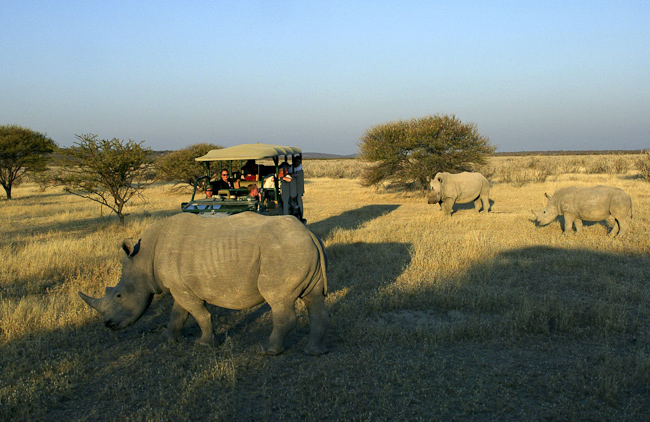
and fauna. The option of tracking White Rhino on foot is available as
are night drives. Additional activities also include full day excursions
into Etosha National Park, taking along a picnic, subject to availability
of vehicles and also a visit to one of the hides on the property. Private
vehicles can be booked at an additional charge subject to availability
either prior to departure or directly with the Camp Manager.
• 2 x 10 seater (7 window seats) Land Rovers (4 x 4 vehicles).
• Game drives on Ongava’s reserve.
• Full day game drives in Etosha National Park with a picnic (optional).
• Walks with an armed guide.
• Private vehicles can be booked at an extra cost (subject to availability).
Wildlife
In central-northern Namibia the flat landscape is dotted with a number of large saltpans, slight depressions made by wind action. The most famous of these is Etosha Pan, which resides in the eponymous Etosha National Park, a vast area of over 20 000km2 that protects an incredible wealth of wildlife. Etosha means 'great white place' and indeed its immense salt pan stretches blinding white across 5 000 square kilometres (120km across and 55km from north to south). Today, a few rivers and occasional heavy summer rains can fill the pan (in good years attracting more than a million flamingos to its salty waters), but for the most part it is parched and dry. While the Pan itself is extremely salty and as a result does not support much vegetation, its edges give way to a surprising variety of vegetation types: from the tall tree canopies of the tamboti and terminalia woodland in the east, to the broad swathe of mopane that envelops the broader area and the open acacia-strewn plains, grasslands and dwarf shrub savannah in the west.
Here mopane woodland dominates, whilst a low row of dolomite hills, evocatively called the Ondundozonanandana Range, provide relief to the otherwise flat surroundings and harbour populations of the endemic Anchieta's dwarf python and the local subspecies of rock hyrax.
Most general game are present on the reserve as well as within Etosha, including springbok, gemsbok, wildebeest, Burchell's zebra, Hartmann's mountain zebra, waterbuck, red hartebeest, giraffe, eland and the endemic black-faced impala. Species that can be seen year round include Elephant, Lion, Leopard, Cheetah, Giraffe, Zebra, Wildebeest, Springbok, Oryx, Kudu and the diminutive Damara Dik-Dik. Elephant and lion move between the Park and the reserve and both black and white rhino can be seen.
Birdlife in Ongava Reserve is prolific with over 340 species to be seen, amongst them 10 of Namibia's 14 endemic bird species. Specials like Bare-cheeked Babbler, Violet Wood-Hoopoe, Carp's Tit and Red-necked Falcon are sought after by birders, while other species such as the Sociable Weaver and its enormous communal nests, the miniature Pygmy Falcon and the brilliantly coloured Crimson-breasted Shrike - justifiably Namibia's national bird. Birding Etosha is also good with Ostrich, Kori Bustard and raptors like Greater Kestrel in abundance. Local specials include Short-toed Rock-Thrush, Namaqua Sandgrouse, Double-banded Courser, Yellow-bellied Eremomela, Spike-heeled Lark and Acacia Pied Barbet.
Ongava Game Reserve
The Ongava Game Reserve is situated on the southern boundary of Etosha National Park, enabling large game such as elephant and lion to move between the Park and the private reserve. Day and night wildlife-viewing drives, visiting hides that overlook waterholes and walks with experienced guides can all be enjoyed exclusively on this reserve. Game drives and daytrips into the easily accessible Okaukuejo area of Etosha National Park are rewarding, with sightings of lion, elephant, gemsbok, springbok, red hartebeest, and white and black rhino. Guests at Little Ongava share a dedicated guide and Land Rover, ensuring the best possible nature experience at one of Africa's great wildlife destinations. A hide at the camp waterhole provides superb photographic opportunities. At Ongava the characteristic wildlife of the area is present, with both desert-adapted black and white rhino to be seen as well as lion.
A highlight at Ongava is that it is one of the few private game reserves in southern Africa where there is a chance of seeing both black and white rhino. For those who enjoy close wildlife encounters, tracking white rhino on foot with a guide is a highlight not to be missed.
Etosha National Park
Etosha was first proclaimed
in 1907. The park originally stretched all the way to the Skeleton Coast
and, up to 1967, was the world's largest park. In 1967, the park's size
was slashed from nearly 10 million hectares to its current size of 2.7
million hectares (about the size of Switzerland). In the early 1990's a
group of Namibian, English, American and South African partners joined
together and bought 30,000 hectares of land on Etosha's southern boundary.
The aim of this venture was to create Namibia's finest private game reserve
and to create a buffer for Etosha along its southern boundary. Ongava (meaning
rhinoceros in Herero) was born, and a massive rehabilitation and restocking
program took place. White Rhino were introduced and over time Black Rhino
migrated onto the reserve. Many thousands of animals are now found on Ongava
including Elephant, Giraffe, Gemsbok (Oryx), Springbok, Red Hartebeest,
Eland, Wildebeest, Zebra and the rare Blackfaced Impala. Lion, Leopard
and Cheetah have also moved back onto the Ongava Reserve. Wilderness Safaris
manages Ongava Lodge and Ongava Tented camp for the owners.
 Top Return to Map of Ongava & Etosha Return to Map of Damaraland & Etosha Top Return to Map of Ongava & Etosha Return to Map of Damaraland & Etosha
For
further information about the National Parks of Namibia, click Nam
Parks
For
History and General information about Namibia, click More
Namibia
|