Kapani Lodge
South Luangwa National Park, Zambia
 Return
to South Luangwa
Camps & Lodges Image © Norman
Carr Safaris Return
to South Luangwa
Camps & Lodges Image © Norman
Carr Safaris
View images of Kapani Lodge: Kapani
Images
KAPANI LODGE RATES: Kapani Lodge
Rates
KAPANI
LODGE -
SOUTH LUANGWA NATIONAL PARK, ZAMBIA
 Kapani is a beautiful, permanent lodge, situated on one of the
many ox-bow lagoons in the South Luangwa. It is the ideal place
for visitors to spend their first night in Africa, before moving
on to the more rustic bushcamps. Kapani is a beautiful, permanent lodge, situated on one of the
many ox-bow lagoons in the South Luangwa. It is the ideal place
for visitors to spend their first night in Africa, before moving
on to the more rustic bushcamps.
Kapani Lodge is situated on a
large lagoon beside the Luangwa River in Zambia's South Luangwa National
Park. Close to the main gate
of the park, the lodge is about a twenty
minute
drive
from Mfuwe
Airport,
ninety minutes or so flight to the East of Lusaka.
Although
the Mfuwe area is busier than other areas of the park, it is
still quiet compared with many other National Parks in Africa. The
advantage of the tradition of camps in this area and the presence
of
people is that game sees the area as safe and is present in very
high densities. Game viewing in the area is by vehicle, and South
Luangwa
is one of the few National Parks which allows night drives.
Norman Carr
Norman Carr
is a conservation legend in the Luangwa Valley. He pioneered walking
safaris in the Zambian bush in
the 1950s and is widely regarded as the father of walking safaris. He spent
over 50 years devoting himself to the development of the South Luangwa
National Park. Norman built Kapani Lodge in 1986 and lived there until
his death in 1996. Norman has probably been more influential
in developing conservation policies and a wildlife tourism industry
in
Zambia than
any other individual. |
Accommodation  For
images of Kapani Lodge, click Kapani
Images For
images of Kapani Lodge, click Kapani
Images
Accommodation consists of eight standard suites
and two new Lagoon Houses, 20 beds all in all. The brick chalets have
thatched roofs, spacious living areas, luxurious interiors and walk-in
mosquito nets. The Lagoon Houses offer more spacious rooms, private
views and elegant furniture.
The rooms are designed
for the warmer weather with high ceilings, overhead fans and large
gauzed windows, all with en-suite facilities.
Dining & Facilities
A thatched building in the centre of camp houses the bar and
lounge area and is a pleasant place to relax between gamedrives.
According to the season, dining is al fresco, with dinner taken
on the terrace and brunch taken on a shady platform overlooking
the lagoon. There are also a main chitenge with a bar and lounge
area and a secluded swimming pool at the far end of camp.
Activities
The Luangwa Valley is regarded as the home of the
walking safaris. During the dry season, those with
a sense of adventure can set out on foot with
a guide and armed scout for morning walks from Kapani
or alternatively enjoy a more extensive foot safari
utilizing one of the nearby bush camps.
Game viewing is in
open 4 wheel drive vehicles or on foot, with activities
being tailored around your requirements.
Game viewing is exceptionally good during the dry winter
months of June through October. Typically small parties
are taken into the park twice daily in open vehicles.
Night drives with
a spotlight are one of the highlights of the Luangwa
Valley, providing the opportunity of seeing nocturnal
animals, particularly leopard, for which the area is
renowned.
Wildlife
The Luangwa Valley has one of the highest concentrations of game In Africa.
Due to the lush riverine vegetation and lots of water, large animal
populations and a variety of birdlife can comfortably be supported. Sightings
of lion and leopard are common. Puku, while not widely distributed
in Africa, are common in the Luangwa. With over 400 resident species,
the Luangwa is a wonderful place to see birds at any time of the
year. However, during the wet months, from November to March, many
migrants arrive and the Luangwa becomes a Mecca for birders.
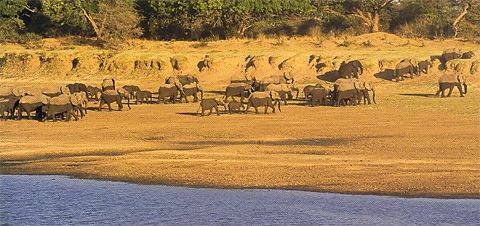
Elephants and hippos: The
Luangwa is known for huge herds of elephants and
large pods of hippos. Of the primates, baboons
and vervet monkeys
are prolific, but Maloney's monkey is scarcer. Present, but unlikely
to be seen except on night drives is the nocturnal
bushbaby. Hyenas are fairly common throughout the valley and their plaintive,
eerie cry, so characteristic of the African bush can be heard on most
nights.
Prides of up to 30: Lions are as plentiful
in the Luangwa as anywhere else in Africa, but when a kill is made away
from the central tourist
area, the pride may stay away for several days and may not be seen by
visitors on a short stay. Very often they roam in prides of up to 30.
Crocodile Heaven: Of the other carnivores present but
not often seen is the caracal, wild dog, serval and side striped jackal.
The Luangwa River also has an extraordinarily high number of crocodiles.
It is not uncommon to see several basking on the riverbanks or even floating
down the river tearing at a dead animal. Night drives are fascinating
in the Luangwa. Not only for the chance of seeing a leopard but for the
many interesting animals that only come to life at night. Others present
are genets, civets, servals, hyenas, and bushbabies as well as owls,
nightjars, the foraging hippos, honey badgers and lion.
Birdwatching - Over 400 species: Birdwatching
is superb in the Luangwa Valley, with over 400 recorded species. Near
the end of the dry season, when the
river and oxbow lagoons begin to recede, hundreds of large waterbirds
can be seen wading through the shallows. The red faced yellow billed
storks move along with their beaks open underwater, disturbing the
muddy liquid with their feet until the fish flop into their mouths.
The pelicans tend to operate in lines abreast, driving the fish before
them into shallows before scooping them up into their beak pouches.
The striking 1.6m saddle bill stork makes quick darting movements into
the water. Then there's the marabou stork, great white egrets, black
headed herons, open billed storks and the stately goliath heron that
can stand in the same position for hours before pouncing. Of the most
beautiful are the elegant crowned cranes, with their golden tufts congregating
in large flocks at the salt pans.
With about 400 of Zambia's 732 species of birds appearing in the valley,
including 39 birds of prey and 47 migrant species, there is plenty for
the birdwatcher to spot, whatever the season.
Special
features of the South Luangwa National Park:
•
Thornicroft's Giraffe
•
14 different antelope species
•
Plenty of leopards
•
47 migrating bird species from Europe and Russia
•
Birds of prey (i.e. Steppe Eagles and Buzzards)
The Kapani School
Project
The Kapani School Project was established in 1986, its aim is to
give an education to children who otherwise would not be able to
go to school.
Yosefe School is the flagship of the project, and Norman Carr Safaris
currently sponsor 40 children, giving them uniforms, books, pens
and pencils,
and also
pay their tuition fees. The project has 34 students at various
high schools all over the region; however, this sponsorship is more
expensive as
they have
more elaborate uniforms, boarding fees, text books and transport
costs. The project also has 4 students that have progressed to
further education. The project originally chose not to send students
to college
since
the costs were so high. A few years ago Kapani sent its first
student to a teachers training college; today that woman is
a qualified teacher
and has returned to Yosefe School.
Yosefe School gets no grant from the government so the project also
undertakes the maintenance of the school. Each year the general fund
puts a
bit aside for maintenance. Over the years Kapani has had several
sponsors who wish to give money for a specific project; as a result
they have
been able to build 2 new teachers' houses, (the government will only
allocate teachers to a school if there is suitable accommodation
for them). They have also put in a borehole and a hand pump. Clean
water is essential to good health and this borehole is a treasure
not only to the school but also to the surrounding communities. They
have also built a new classroom block and recently renovated the
existing two blocks and replaced all the desks.
The project also teaches the children conservation awareness, twice
a month groups of kids are brought into the National Park to watch
the animals.
The project also gives lectures on many conservation issues. The
general attitude towards wildlife in the villages is negative, elephants
destroy crops,
lions eat people or livestock, and impala are just meat to eat. However
due to Kapani's efforts,
it is very rewarding to see the changing attitudes in these young
children.
A couple of years ago they organised a tree
planting competition and the winners were treated with a night
at one of the Norman Carr bushcamps. They just loved it!
There is a lot of suspicion these days about so called “charities”;
so much is spent on administration that not much is left for the
intended purpose. The Kapani project is different; all members
are volunteers and no one gets an allowance or a salary. Hence
every
penny generously
donated goes directly to educate these kids.
 Top Return
to South
Luangwa Camps & Lodges Return
to Map
of Zambia Top Return
to South
Luangwa Camps & Lodges Return
to Map
of Zambia
For
History and General information about Zambia, click More
Zambia
For
further information about the National Parks of Zambia, click Zam
Parks
|