Savuti Camp
Linyanti Wildlife Reserve, Botswana
 Return to Map of Linyanti Reserve Return to Map of Linyanti Reserve
View images of Savuti Camp: Savuti
Images
View Camp Layout Map of Savuti Camp: Savuti
Map
SAVUTI CAMP RATES: Savuti Camp
Rates
SAVUTI CAMP - LINYANTI WILDLIFE
RESERVE, BOTSWANA
Savuti Camp is situated in an isolated part of the Linyanti Concession along the Savute Channel in northern Botswana. The site of the camp is about 17 kilometres 'downstream' from the Zibadianja Lagoon - the source of the Channel. The Channel stopped flowing between 1980 and 2008; during this time it was an unusual and productive ribbon of grassland that served as a corridor and feeding ground in the surrounding woodland for a wide variety of herbivores.
To enhance viewing: After clicking Play, click the Pause button to allow the video to buffer.
(clicking HD toggles off High-Def quality and will speed buffering but reduces video quality)
In 2008 the Savute Channel once more became a deep, clear waterway harbouring hippo and aquatic life with myriad varieties of waterbirds. Wildlife, from plains game to a plethora of predators, has had to adapt to a new source of water and all the opportunities and menaces it has brought with it. For different species the Channel has become a place of refuge, an obstacle, an unrivalled food source, a navigational aid, a larder, a playground, and a graveyard. It is impossible to say yet whether the waters will persist or begin to recede in earnest as much of this will depend on the next summer rains - but while it lasts, at Savuti there are front-row seats for each drama that is played out.
With two-thirds of the Channel located in the concession, Savuti Camp's guests have private and exclusive access to the abundant game and the natural and geological changes that are occurring on a daily and seasonal basis..
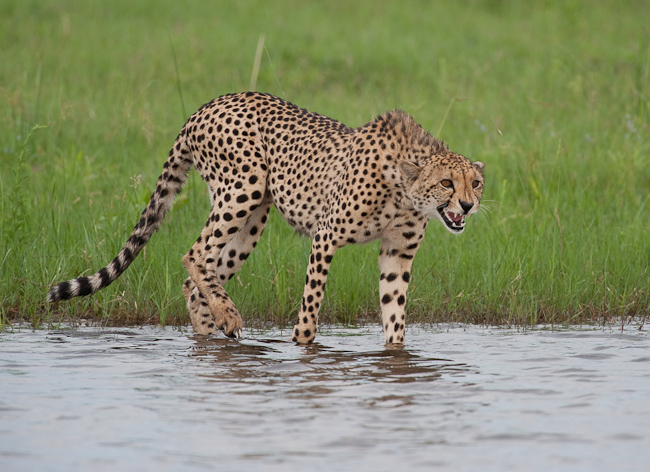
James' Note: Whilst Savuti Camp is not a water camp per se (no boating currently on offer other than some canoeing from camp), water is now a major component of every game drive, as the channel and it's increasing water levels cannot be missed. During our December 2008 Digital Photo Safari, we watched cheetahs, lions, ostriches and hyenas swwimming across the channel on a regulare basis. You can even catch a nice bream right from the main deck my casting a fishing line right into the channel!
Accommodation  For images of Savuti, click Savuti
Images For Layout map of Savuti Camp, click Savuti
Map
For images of Savuti, click Savuti
Images For Layout map of Savuti Camp, click Savuti
Map
Savuti Camp is a small and
intimate camp in an isolated area, far from any other people. Accommodation
at Savuti is in seven large comfortable walk in tents with en-suite facilities.
Each tent is raised off the ground on platforms and has its own bathroom
with a shower, hand basin and flush toilet. All of the new tented rooms have indoor showers and loos and the tents all provide views of the now-flowing Savute channel waters. One of the seven tents is a family room, configured using two tents side-by-side, each with its own separate en-suite facilities.
There is a separate dining
room and pub under reed and thatch, also on raised platforms, as well
as a plunge pool. There is a plunge pool and large viewing area with fire pit which extends outwards on raised wooden decks towards the Channel. Complimentary laundry services are provided.
Activities
Explore the Channel and its environs through day and night game drives, nature walks with a guide (on request), and several well-positioned hides for safe, up-close animal viewing. Savuti Camp's famous 'wood-pile hide' at the waterhole in front of camp is now part of the flowing Savute Channel and unfortunately no longer accessible.
Wildlife
Game concentrations here are high, especially in
the winter months. Besides your normal plains game, the area has good
concentrations of Roan, Sable and Giraffe. All the predators occur in
the area - Lion, Leopard, Cheetah, Wild Dog and Hyena. We have already
identified 40 different Lion along the Savute channel around the camp.
The Chobe/Linyanti area is renowned for its dense Elephant population
and for some of the best Elephant viewing anywhere in Africa in the winter
months. As the waterhole in front of the camp is the only supply of water
for a large area in the dry winter months, one of the highlights for
Savuti
Camp is the fantastic wildlife viewing directly from the camp.
NG 15 - The Linyanti Wildlife Reserve
The 125 000-hectare (308 000-acre) private Linyanti Concession bordering Chobe National Park's western boundary is an enormous, wildlife-rich area, shared between just three small camps (DumaTau, Kings Pool and Savuti Camp), which creates an unrivalled atmosphere of remoteness and space.
There are three main features of the Linyanti Concession: the Linyanti River, the woodlands of the interior and the well-known Savute Channel, famous as a sporadic and unusual watercourse. The Channel stopped flowing between 1980 and 2008; during this time it was an open grassland, home to a wide variety of animals. In 2008, the Savute Channel once more flowed, creating a water source that rapidly filled with aquatic life, wide varieties of waterbirds, and hippo, amongst other changes. With two-thirds of the Channel located in the concession, Wilderness guests have private and exclusive access to its abundant game.
These three features together with the floodplains, woodlands, grasslands, palm islands and scrub vegetation of the area harbour one of the densest dry season concentrations of elephant in Botswana - at times the Linyanti must have several thousand elephants roaming around. This phenomenon is one of the main attractions for travellers to northern Botswana, but the area is also important in holding good numbers of predators, providing an integral stronghold for species like the critically endangered wild dog, as well as lion, cheetah and spotted hyaena. The roan antelope found in the area can provide an equal thrill however, as can the high concentration of birds of prey, seasonal zebra congregations and the cathedral-like woodland of mature mopane trees.
Aside from roan, other plains game includes red lechwe, Burchell's zebra, blue wildebeest, impala, common waterbuck, sable, eland, southern giraffe, chacma baboon, vervet monkey, warthog, hippo and Cape buffalo. Nocturnal species often seen are lesser bushbaby, spring hare, aardwolf, serval, large spotted genet and if you are extremely lucky the elusive pangolin!
Birding is outstanding here ranging from the Okavango specials, such as Slaty Egret, Hartlaub's Babbler, African Skimmer, Allen's Gallinule and Wattled Crane, to the drier mopane woodland species like Racket-tailed Roller, Bradfield's Hornbill, White-breasted Cuckoo-shrike, Bennett's Woodpecker, Swallow-tailed Bee-eater and Arnott's Chat. This area is also excellent for Kori Bustard, Ostrich, Secretarybird, and Ground Hornbill with Southern Carmine Bee-eaters in summer. The Savute Channel is famous as an area with a high concentration of eagles and raptors and this area is internationally recognised as an IBA (Important Bird Area), particularly for birds of prey like Dickinson's Kestrel and waterbirds. There are also various owl species to be seen here such as Verreaux's (Giant) Eagle-Owl and African Scops-Owl.
The many varied habitats within these areas - marshes, waterways, riverine forests, dry woodlands and grasslands - and the prolific and diverse wildlife and spectacular scenery together form a wonderful contrast to the Okavango. Adding this area to a Botswana itinerary makes for a varied and balanced experience of the country and in many ways it is an essential complement to a visit to the Okavango.
Conservation
Perhaps the most topical issue for Botswana at present is its very large elephant population and the possible impact on vegetation and other animal species. As a result and in recognition of the fact that in the Selinda and Linyanti Concessions Wilderness Safaris is responsible for one of the two highest-density elephant concentrations in the country, we have facilitated and partially funded two MSc studies examining vegetation impact and are currently hosting a PhD and further MSc researcher examining additional elements of this puzzle.
Botswana has a well-developed network of protected areas, and these include concessions that allow hunting as well as photographic safaris. We have chosen not to hunt in the concessions in which we operate and forfeit approximately US$1.2 million per annum in hunting quotas that we choose not to take up in preference for photographic safaris.
 Top Return to Map of Linyanti Reserve Top Return to Map of Linyanti Reserve
Water
/ Land Activity Table for Botswana camps: Water/Land
Botswana
Flying
Times between Botswana camps: Fly
Times Botswana
For further information about Botswana, click More
Botswana
For further information about the Linyanti Wildlife Reserve, click More
Linyanti
|