Jao Camp
Okavango Delta, Botswana
 Return to Map of Okavango
Delta Camps
Return to Map of Okavango
Delta Camps
View images
of Jao Camp: Jao Images
View Camp Layout Map of Jao Camp: Jao
Map
JAO CAMP RATES: Jao
Camp Rates
JAO CAMP
- OKAVANGO DELTA, BOTSWANA
Jao Camp is situated in the Jao Reserve, an area
of 60,000 hectares, in Botswana's Okavango Delta. The Jao reserve borders
on the Moremi Game Reserve, to the west of Mombo Camp,
on a densely wooded, oval-shaped island. This area comprises a superb
variety of habitats, ranging from permanent waterways and lagoons on the
one extreme to thick Kalahari soils on the other. In the central region of the concession, vast open floodplains provide some of the most stunning scenery Botswana has to offer. Jao Camp lies on the southern side of the plains, an area with beautiful islands fringed with riverine forests.
Accommodation  For images of Jao, click Jao Images For Layout map of Jao Camp, click Jao
Map
For images of Jao, click Jao Images For Layout map of Jao Camp, click Jao
Map
Jao Camp has nine spacious, beautiful tents, each individually handcrafted. These twin-bedded canvas and thatched rooms are situated beneath a canopy of shady trees and have en-suite facilities, as well as an outdoor shower for the more adventurous. Built on raised decks, each has a private sala for afternoon siestas and offers wonderful views of the spectacular surrounding floodplains of Botswana. In addition to the lounge and dining area, there are two plunge pools and an outdoor boma for dining under the stars, complemented by wines from an excellent wine cellar. Jao Camp also has a salon where a wide range of massage therapies are offered.
Activities
Jao can offer both land and
water activities, depending on the fluctuating levels of the Okavango's
floodwater. From about May to late September, the floods arrive and the
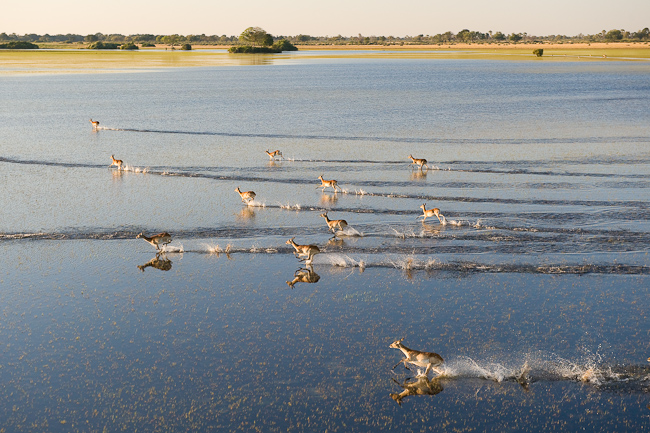
floodplains fill up with crystal clear waters. As the floods arrive,
the focus at Jao switches more to water activities with game drives on
the larger islands. From October to April, the flood levels drop and
the floodplains turn into savannah grasslands. Nowhere in the Okavango
do we experience more extreme contrasts in the seasons. Jao is therefore
a multi-activity camp. Mekoros, boating, walks, game drives and night drives
are all on offer all year. The primary focus of the activities changes
according to the time of year and the flood levels.
Wildlife
A variety of habitats ensures diverse and interesting
game viewing. The wildlife at Jao depends largely on the water levels
in the area. The lagoons are home to Hippo and Crocodile and the permanent
waters attract large numbers of waterfowl. In the permanent waters, Sitatunga
can be tracked silently by mokoro. From October to March
the waters subside and enormous open plains are the highlight. This is
where the game viewing is the best. Lion, Cheetah and Leopard are plentiful,
while Tsessebe, Red Lechwe, Zebra and Wildebeest dot the flood plains.
During the winter months, the water levels at Jao rise and the savannah
areas become covered with water.
NG 25 - The Jao Concession
The Jao Concession is 60 000 hectares in extent and is in the north-western area of the Okavango Delta below the Panhandle. The Moremi Game Reserve forms the eastern boundary of the concession.
The Okavango Delta rests between shallow fault lines at the end of the Great African Rift Valley. Deserts are low on annual rainfall and the Okavango Delta is no exception. However, each year floodwater flows into the Okavango Delta from its source in the moist African highlands over 1000 km away. These floodwaters flow from their catchment southwards and into the Kalahari Desert to create a unique wetland that supports and sustains the huge diversity of wildlife in the Okavango Delta.
Lying as it does in the very heart of the Okavango Delta, the Jao Concession embodies all the magic and mystique of Botswana. Narrow water channels cut their way through the papyrus and reed beds in the permanent delta to the north and east of the Jao Concession, providing the perfect environment for the elusive sitatunga and the rare Pel's Fishing-Owl. Beautiful lush palm islands dot the water, begging to be explored.
Further west the area gets progressively dryer and Hunda Island, which is the tip of a large 'sand tongue,' is the largest area of dry land in the Jao Concession during the flood season. Hunda Island has sandveld vegetation supporting many species of nutritious acacia and grewia shrubs which provide excellent browsing.
It is perhaps the birds for which the true wetland areas of the Okavango Delta are best known however. The largest concentrations of endangered Wattled Crane are found in this area and Slaty Egrets, Rosy-throated Longclaws and African Skimmer are some of the specials that can be seen. Hallowed species such as Pel's Fishing-Owl and Slaty Egret are found alongside more conspicuous and commonly seen Coppery-tailed Coucal, Pygmy Goose, while the specialised African Skimmer (from which Wilderness Safaris takes its logo) may be seen on the larger lagoons and channels in the Jao Concession.
The Jao Concession is set in the most densely populated wetland area for sitatunga antelope and red lechwe, and of course hippo and crocodile are regularly sighted. In the dry season lechwe, tsessebe, elephant, wildebeest and zebra occur here, and lion, cheetah and leopard are often sighted on the floodplains. The lion prides in this area of the Okavango Delta have been extensively studied in recent years, thereby building up a more intimate knowledge of their behaviour.
Conservation
Jao is involved in the Jao Lion Monitoring Project, which was begunsoon after the camps in the Jao Concession opened. Individual lions are identified, and every effort is made to keep track of their movements, social behaviour and condition. Over the years some unusual behaviour and intriguing developments in the various lion prides have been documented. Read more: Jao Lion Monitoring Project
Jao Concession holder, David Kays, is a member of the Tubu Joint Management Committee which he was involved in launching together with the University of Botswana under the auspices of the Biokavango Project. The aim of this committee is to reduce conflict between the community and the Jao Concession - specifically with regard to curbing poaching and over-fishing. We hope to assist the community with developing tourism ventures in their area.
The Owners
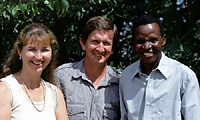 David and Cathy Kays and their families and Kingsley Mogalakwe are the long-term
leaseholders of Jao Reserve. The Kays are one of Maun's oldest families. David's
great grandfather first came to Ngamiland in 1887. In 1912 the Kays family settled
in Tsau, at that time the headquarters of the Batawana tribe (Maun was not yet
founded). When the Batawana tribe decided to establish a new village at Maun
and move its headquarters there in the mid-1920's, the Kays family moved with
them. David's father, Ronnie, was instrumental in advising the Batawana Tribal
Authorities on the formation of Moremi Game Reserve and assisted in the demarcation
of the reserve's boundaries. Kingsley Mogalakwe is from a prominent and well-known
Maun family. His uncle, Montsho Mogalakwe, was also instrumental in the formation
of Moremi Game Reserve and has now retired from service in Maun as the deputy
chief for Ngamiland. David and Cathy Kays and their families and Kingsley Mogalakwe are the long-term
leaseholders of Jao Reserve. The Kays are one of Maun's oldest families. David's
great grandfather first came to Ngamiland in 1887. In 1912 the Kays family settled
in Tsau, at that time the headquarters of the Batawana tribe (Maun was not yet
founded). When the Batawana tribe decided to establish a new village at Maun
and move its headquarters there in the mid-1920's, the Kays family moved with
them. David's father, Ronnie, was instrumental in advising the Batawana Tribal
Authorities on the formation of Moremi Game Reserve and assisted in the demarcation
of the reserve's boundaries. Kingsley Mogalakwe is from a prominent and well-known
Maun family. His uncle, Montsho Mogalakwe, was also instrumental in the formation
of Moremi Game Reserve and has now retired from service in Maun as the deputy
chief for Ngamiland.
Like all families raised
in and around the Okavango, wildlife was in their blood, and they spent
most of their lives out in the bush. When they won the rights for the Jao
Reserve in the recent tender process, they were determined to make this
Botswana's finest reserve. They turned their backs on hunting, even though
it is allowed in this reserve. |
 Top
Return to Map of Okavango
Delta Camps
Top
Return to Map of Okavango
Delta Camps
Water
/ Land Activity Table for Botswana camps: Water/Land
Botswana
Flying
Times between Botswana camps: Fly
Times Botswana
For further information about the Okavango Delta, click More
Okavango
For further information about Botswana, click More
Botswana
|